
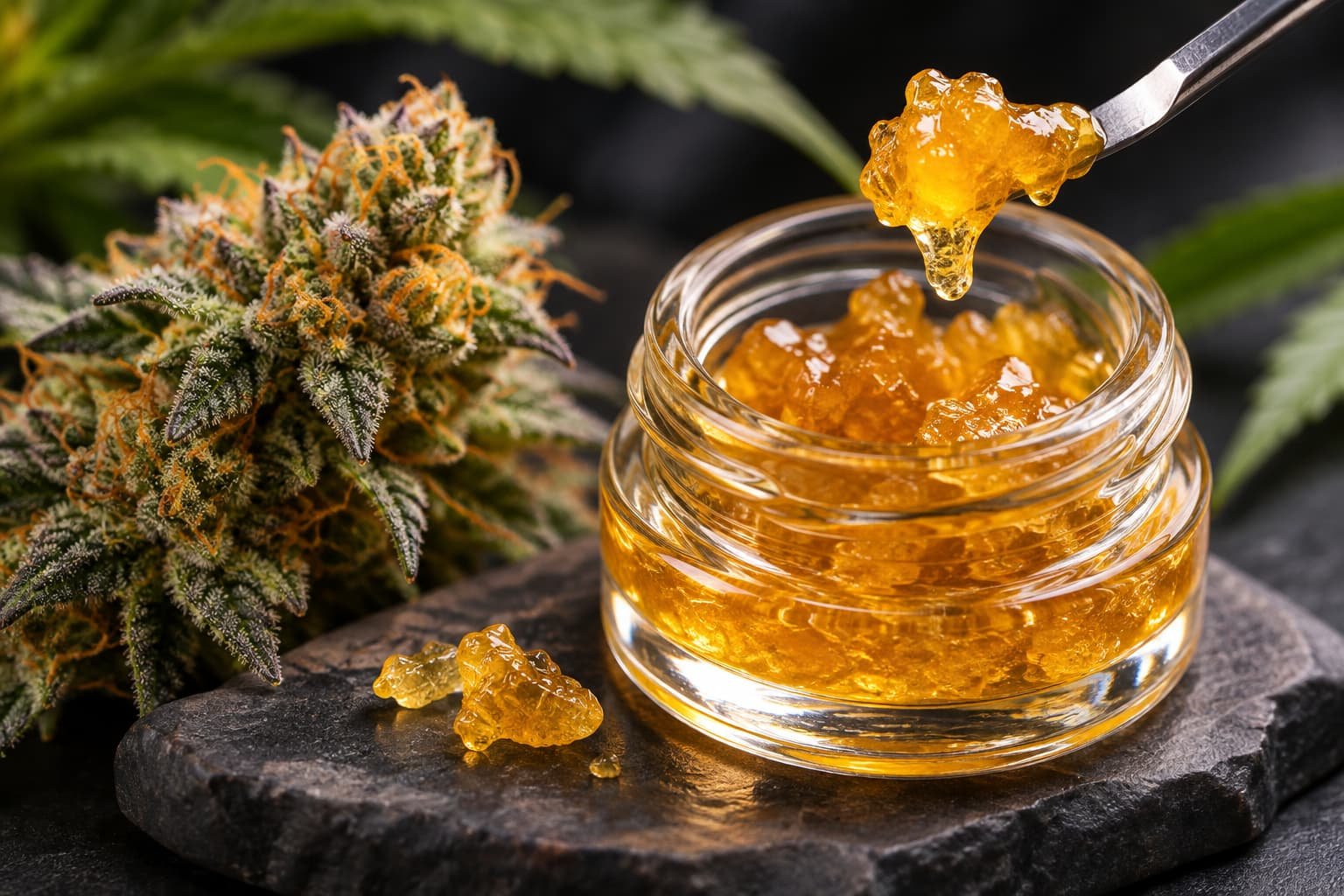
From Flower to Live Resin: Why Fresh-Frozen Cannabis Matters
Every cannabis concentrate has a starting point.
Before live resin becomes a golden extract with a distinctive texture and aroma, it begins as cannabis flower.
The genetics, cultivation conditions, maturity, and post-harvest handling of that flower help shape the compounds that can eventually appear in the finished concentrate.
This is why understanding fresh-frozen cannabis is essential to understanding live resin.
While different extraction technologies can transform the physical appearance of cannabis, they cannot completely separate the final product from the characteristics of its original plant material.
Let’s explore the connection between cannabis flower, trichomes, terpenes, and the concentrates produced from them.
What Makes Cannabis Flower Unique?
Cannabis flower contains a complex mixture of naturally occurring compounds.
Some of the most discussed include cannabinoids such as THC and CBD, along with terpenes that contribute to the plant’s aroma.
The relative concentrations of these compounds vary.
Different cultivars may produce distinct aromatic profiles and cannabinoid compositions, even when grown under similar conditions.
Cultivation practices, harvesting decisions, and environmental factors can further influence those characteristics.
These variations help explain why cannabis extracts made from different source materials do not necessarily have identical chemical profiles.
Fresh-Frozen vs. Dried Cannabis: What Changes After Harvest?
Traditional cannabis flower production generally involves drying and curing after the plant is harvested.
These processes influence moisture content, aroma, and other properties of the finished flower.
During drying, certain volatile compounds can evaporate or undergo chemical changes.
Fresh-frozen cannabis follows a different post-harvest route.
Instead of completing the conventional drying process, harvested cannabis is frozen shortly afterward.
This approach is commonly associated with the production of concentrates such as live resin and live rosin.
The goal is to limit some of the changes that can occur before extraction.
However, freezing does not preserve every plant compound indefinitely, and the quality of the final extract still depends on subsequent processing.
Trichomes: Where Flower Meets Extraction
One of the most important connections between cannabis flower and concentrates involves trichomes.
Trichomes are specialized structures found on the surface of cannabis plants.
Certain glandular trichomes produce and store cannabinoids and terpenes.
Their presence contributes to the crystalline appearance commonly associated with resin-rich cannabis flowers.
During concentrate production, processors seek to collect compounds from these structures while separating out much of the remaining plant material.
Different extraction techniques accomplish this in different ways.
Solvent-based methods dissolve extractable compounds.
Mechanical processes, such as those used in solventless hash and rosin production, separate or press resin-rich material without chemical extraction solvents.
The underlying source remains the cannabis plant.
Why Cannabis Genetics Matter to Live Resin
Genetics influence the range of chemical characteristics a cannabis plant may express.
This includes the potential composition of its cannabinoids and terpenes.
For example, two cultivars may have noticeably different aromatic profiles because they produce different combinations and concentrations of volatile compounds.
Those differences can also influence their respective extracts.
However, extraction is not a perfect reproduction of the living plant.
Some compounds may be lost, separated, transformed, or altered throughout processing.
Therefore, an extract made from a particular cultivar may share certain characteristics with its original flower without being chemically identical to it.
From Fresh-Frozen Flower to Live Resin
Live resin production typically uses frozen cannabis material processed through a commercial solvent-based extraction system.
The process separates cannabinoids and other extractable compounds from the plant.
The resulting material is then refined and prepared for its intended product format.
Depending on its composition and finishing method, live resin may appear as sauce, sugar, badder, or another concentrate texture.
The defining characteristic is not the colour or consistency.
It is the use of fresh-frozen cannabis as the starting material for the extract.
Live Resin vs. Traditional Cannabis Flower
Although live resin and dried flower may come from the same cultivar, they are very different products.
| Characteristic | Dried Cannabis Flower | Live Resin |
|---|---|---|
| Form | Dried plant material | Concentrated cannabis extract |
| Post-harvest treatment | Typically dried and cured | Fresh-frozen before extraction |
| Plant structures | Flower tissue remains present | Much plant material is removed |
| Terpene profile | Influenced by drying and curing | Influenced by freezing and extraction |
| Cannabinoid concentration | Generally lower | Often substantially higher |
| Appearance | Recognizable buds | Oil-like, creamy, crystalline, or other forms |
Neither category automatically provides a more complete or superior representation of a particular cultivar.
They are different products created through different processes.
What About Live Rosin and Distillate?
Understanding flower also helps explain the distinctions between other extract categories.
Live rosin can begin with fresh-frozen cannabis that is processed into hash and mechanically pressed using heat and pressure.
Distillate is produced through additional refining that concentrates particular cannabinoids and removes or separates much of the original extract’s other constituents.
These methods emphasize different outcomes.
Live resin and live rosin are frequently associated with preserving more of the source plant’s aromatic compounds.
Distillation focuses on isolating and refining cannabinoids.
The resulting chemical profiles vary based on the product and manufacturing process.
Does Better Flower Always Create Better Live Resin?
High-quality starting material is important, but flower appearance alone cannot guarantee the quality of a finished extract.
The source plant’s chemical composition, cultivation conditions, harvesting practices, and handling all influence the material available for extraction.
The extraction process introduces its own variables.
Equipment, processing controls, storage, and contamination testing also affect the finished product.
A visually appealing flower may be a promising starting point, but it is not a substitute for quality assurance.
Can Live Resin Preserve the Original Strain’s Aroma?
Preserving aromatic characteristics is one of the main goals of fresh-frozen extraction.
By avoiding conventional drying before extraction, producers aim to retain more of certain volatile compounds.
However, not every terpene survives every stage of processing unchanged.
The exact aroma and chemical composition of a finished live resin product depend on the original cultivar and the manufacturing process.
Describing live resin as an exact copy of the living plant would therefore be an oversimplification.
Why the Original Flower Still Matters
Modern cannabis extraction technology can create a wide variety of concentrates from plant material.
But the plant’s genetics and chemical composition establish the starting point for these processes.
An extract cannot be fully understood without considering what went into it.
For people interested in cannabis flower, studying concentrates provides another perspective on the compounds found within the plant.
It also demonstrates how post-harvest decisions can shape a finished cannabis product.
Frequently Asked Questions
What does fresh-frozen cannabis mean?
It refers to cannabis frozen shortly after harvest, before completing the conventional drying and curing process.
Can any cannabis strain become live resin?
Many cannabis cultivars can serve as extraction material, but their suitability and final extract characteristics depend on the source material and processing conditions.
Is live resin made from premium flower?
Live resin can be produced from different grades and types of cannabis material. The label alone does not guarantee a particular flower quality grade.
Does live resin have the same terpenes as the flower?
It may preserve some of the source plant’s terpene profile, but the final composition can differ because of harvesting, freezing, extraction, and storage.
Is live resin more potent than flower?
Live resin is a concentrated cannabis extract and generally contains a higher cannabinoid concentration than dried flower. Concentrated products can also present greater risks of THC overconsumption.
The Walt Herb Co. Perspective: Quality Begins With the Plant
Cannabis concentrates demonstrate how processing can transform the structure and composition of flower.
But extraction technology is only one part of the story.
Genetics, cultivation, harvesting, and post-harvest handling establish the conditions from which the finished product develops.
At Walt Herb Co., understanding cannabis starts with appreciating the flower itself: its natural variation, its chemical complexity, and the characteristics that make different cultivars distinct.
Whether examining dried flower or learning about fresh-frozen extracts, the most important foundation remains the plant behind the product.
Educational content for adults 19+ in Ontario.
